The Magic at the Booth: Real Stories, Raw Conversations, and the True Heart of Honey on Duty
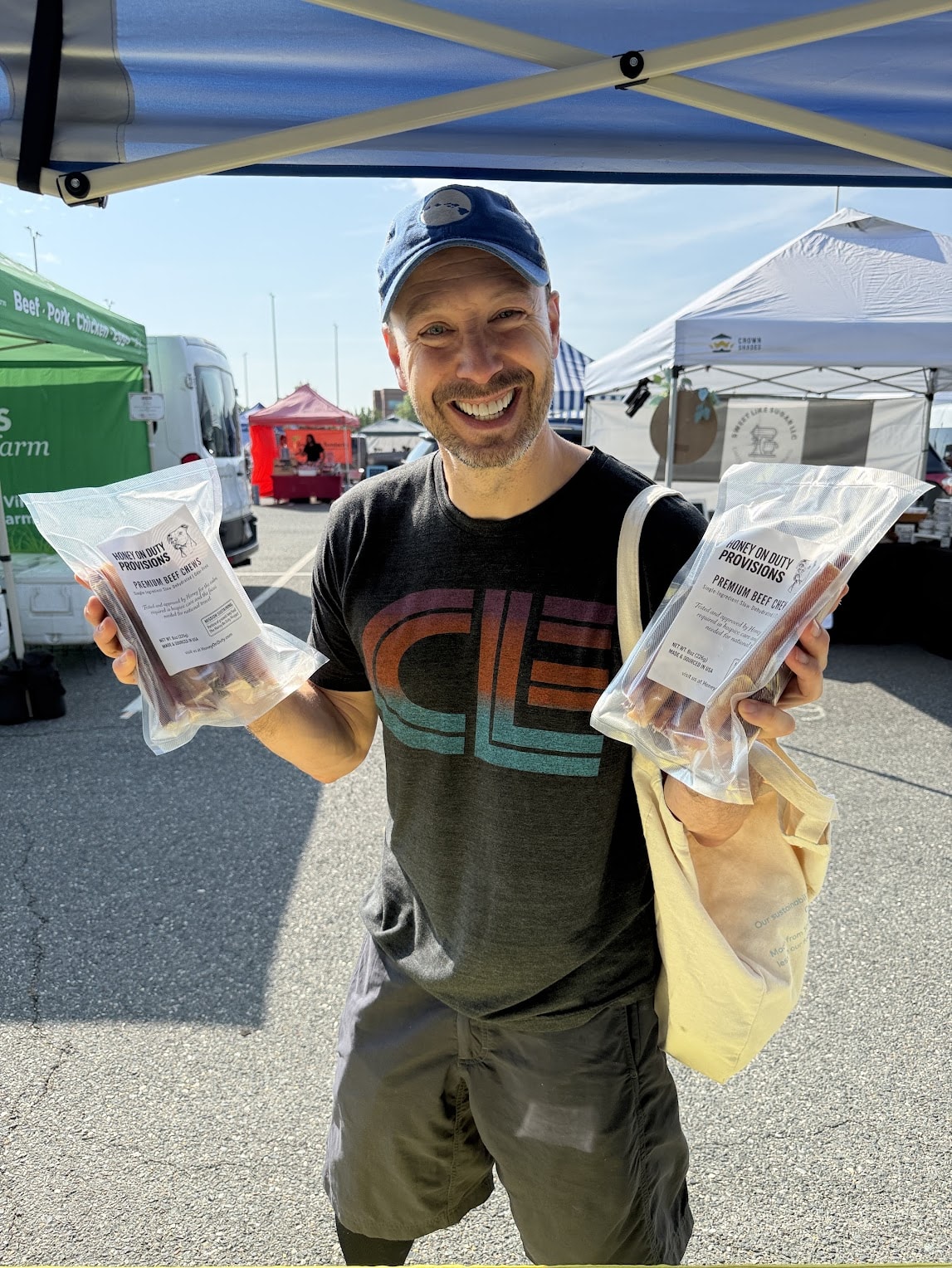
Markets are loud, crowded, and relentless. Rows of white tents stretch down the avenue, vendors call out prices for their wares, and footsteps shuffle by on pavement in an endless rhythm. If you are just walking past, it is easy to see another vendor selling dog treats, 3D-printed keychains, and handmade pet chews.
But step just a few feet closer — step past the signage — and the entire atmosphere changes. People don't just stop to browse. They stop because of Honey.
Honey — a five-year-old, twice-returned shelter rescue turned certified therapy dog, service dog, and local celebrity gracing the cover of Stafford Living Magazine — lies calmly in her van or greets visitors with a soulful, grounding gaze. She has flown on 33 airplanes across 15 different states, working in hospitals, hospice centres, and community crises. But the real magic of the Honey on Duty booth isn't just Honey's impressive résumé or her calm demeanour. It happens in the unscripted, deeply human conversations that unfold across the table all day long.
To understand what makes the Honey on Duty booth special, you don't look at the sales ledger. You listen to the transcripts of a single market day — the exact moments, words, and emotional exchanges between Stefan, Honey, and the strangers who walk up to the table.
The Ritual of the Magic Key: The Honeygram Station
The centrepiece of the booth — built entirely by Stefan using a 3D printer — is the Honeygram station. It is an interactive workshop based on a simple premise: strangers writing to strangers. But Stefan has built a strict rule into the experience. To write a note, you first have to receive one.
Visitors are handed a "magic key," instructed to insert it into a 3D-printed slot, turn it halfway, and pull open the mailbox to reveal notes left by previous visitors. Throughout the day, watching families, children, and veterans unlock that box is like watching people drop invisible armour.
When a young girl opens a card and reads, "You are so very loved. The world is better because you are in it," or when another visitor reads, "Failing is okay; it's how we recover that matters," something shifts in the space. The noise of the market fades. Children pull up chairs to draw meticulous hearts and smiley faces with orange and pink pens, while adults pause, read the words, and reflect on what it means to offer unvarnished kindness to someone they will never meet.
Stefan tells visitors again and again: "The fastest way we can change how people feel is with our words." And watching people from all walks of life sit down at the 3D-printed table to write those words proves him right.
A Magnet for Grief, Healing, and Shared Humanity
What transforms the booth from a standard market stall into an emotional sanctuary is how quickly superficial small talk gives way to profound personal truth. People don't just talk about dog treats; they talk about survival, loss, and the dogs that saved their lives.
Take the visitor who stops by early in the day while Stefan is talking about rescue animals. The conversation turns naturally to the heavy realities of life. The visitor opens up about a son-in-law in the Navy who was run over by a forklift in Hawaii back in April, losing the lower half of his leg, now recovering at Walter Reed. His wife had recently talked about getting a service dog, to which Stefan warmly replies, "You have two right here. Do you really need a third?" It is a heavy, staggering piece of news dropped in the middle of a market aisle, yet met with instant empathy, shared warmth, and a reminder that survival takes a village — and often, four paws.
Minutes later, another couple lingers by the van. The conversation wanders from Virginia's unpredictable "nine seasons" weather to the deep, aching bond of losing a soul dog. One visitor shares how their husky shepherd mix passed away last September after losing her ability to walk. The shared grief is immediate and wordless — anyone who has loved and lost a large dog knows the exact weight of that emptiness. Stefan listens, sharing his own philosophy: "A dog comes into your life when you need it the most, and I truly believe that."
The Pit Bull Paradox and the Weight of Stereotypes
Throughout the day, the conversation frequently returns to rescue dogs — specifically pit bulls and pit mixes. Honey is a 96% pit bull mix with a two percent hint of wolf on her DNA test, a fact Stefan jokes about by asking who in her family tree was "promiscuous" with a wolf.
Visitors walk up, charmed by Honey's copper coat and gentle eyes, often remarking on how sweet she is. That admiration opens the door to deeper discussions about breed stigma. Stefan shares the history of Sergeant Stubby, the decorated World War I Marine Corps dog, and reminds visitors that pit bulls were historically known as "nanny dogs" — loyal, loving companions for children.
When other dog owners approach with their rescues — like a couple introducing their pit-shepherd mix, Coco (affectionately nicknamed "Bear Bear") — the booth turns into a support group for rescue advocates. A visitor opens up about her previous soul dog, Hampson, sharing a vivid, tearful dream she had after he passed away where her late grandparents knocked on her front door and Hampson bounded up the steps to kiss her face. Instead of brushing it off as coincidence, Stefan validates the experience completely: "I have an odd belief system... heaven's not as far as people believe. It's just on the other side of the veil." In a market full of commercial transactions, a vendor pausing to hold space for someone's spiritual grief over a departed pet is revolutionary.
Humour, Engineering, and the Solo-Operator Grind
Behind the deep emotional connections, a market booth is still run by a human being juggling a mountain of logistics. Stefan runs the show with a mix of dry wit, technical ingenuity, and self-deprecating humour.
When people ask about his signage, displays, mailboxes, and business cards, Stefan proudly explains that he printed them all himself on his 3D printer. He jokes about his past life running seven 3D printers producing $5,000 a month before donating them to CyberBytes for a tax write-off, upgrading to a multi-colour printer, and using AI to help design his gear.
He banters with recurring visitors, jokes about his hair — recounting how he shaved his head after raising $9,000 for breast cancer with pink hair, instantly regretting it, and now growing it back as fast as humanly possible — and manages the delicate balance of booth management. Between fielding questions about beef collagen sticks, lamb pizzle, and lamb lung, Stefan is also coordinating pet-sitting logistics with his wife, checking in on local market schedules, and handing out pink NFC keychains that instantly beam Honey's website straight to a customer's phone when tapped.
The Children's Table: Teaching Empathy One Drawing at a Time
Perhaps the most life-affirming moments at the booth happen when children pull up a chair. Throughout the day, groups of kids — some visiting with their families, others running around with friends — swarm the Honeygram station.
Stefan doesn't talk down to them. He treats them like full participants in the mission. "You guys each know how to write words, right?" he asks a group of young boys. He guides them through unlocking the mailbox with the magic key, helps them read messages left by strangers, and hands out coloured paper and markers.
The kids take it seriously. Little hands draw careful hearts, smiley faces, and bubble letters spelling out messages like "You are awesome" and "I hug honey when I'm sad, so I feel that." One young girl fills her card with intricate, beautiful drawings. When she finishes, she proudly drops her envelope into the mailbox, completes the mission, and walks away with a red or yellow Honey figurine.
By engaging children in an act of anonymous generosity, Stefan is planting seeds of empathy that stretch far beyond the festival grounds. These kids aren't just buying a toy; they are learning that their creativity and kindness can directly alter the emotional state of a complete stranger.
More Than Dog Treats
As the market day winds down and the five-minute warning for pack-down begins, the true identity of the Honey on Duty booth comes into sharp focus.
Yes, it is a business. Stefan is selling handmade, smoked, and dehydrated dog chews to fund a nonprofit. Yes, it is an innovative showcase of 3D-printed products and clever NFC marketing.
But looking back over the transcripts of the day — the tears shed over lost dogs, the heavy burdens shared by military families, the laughter over wolf-mix DNA tests, the children writing letters to strangers, and Honey resting quietly in her van as a living anchor of peace — it is clear that the booth is something much larger.
The Honey on Duty booth is a living, breathing community centre built on four wheels and four paws. It proves that in a world that feels increasingly fragmented, loud, and digital, people are desperately hungry for real connection, authentic empathy, and a safe place to land. And all it takes is a magic key, a handwritten note, and a sweet shelter dog named Honey to remind everyone walking down that crowded aisle that they are seen, they are valued, and they are never truly alone.
The Honey's Insider
Get treat tips, Honey updates & first dibs on new products.
No fluff. Just good stuff for dogs who deserve better.